


1

Bet88 Casino
- PAGCOR-Licensed
- Fast and secure cash-in and cash-out
- Accepts crypto
Bitcoin casinos in the Philippines accept BTC deposits, either alongside pesos and local e-wallets, or as the only way to fund an account. A deposit with pesos passes through an exchange that turns local currency into coins, the blockchain the transfer travels on, and the cashier of the operator. The exchange and the cashier set their own limits and charges, while the network decides the fee and how long a confirmation takes.
This page covers which coins and networks cash desks accept, where fees appear, what determines how long a transfer takes, and what to check before sending funds. Our full list of Philippine online casinos covers operators working with other payment methods as well.
1
Bet88 Casino
2

Planbet Casino
3

BC.Game Casino
4

Betso88 Casino
5

Milyon88 Casino
6

DragonSlots Casino
7

Stake Casino
8

Cwinz Casino
9

Winwin Casino
10

MelBet Casino
11

Paripesa Casino
12

BetWinner Casino
13

BK8 Casino
14

Ice Casino
15

Roobet Casino
16

20Bet Casino
17

Ivibet Casino
18

Spin Samurai Casino
19

Zoome Casino
20

King Billy Casino
Crypto deposits and bonus offers do not always work together. Some operators exclude such deposits from the welcome package, others accept them but apply a separate minimum. The terms of the promotion state which of the two applies, along with the wagering multiplier, the maximum bet allowed while the bonus is active, and the validity period.
Availability depends on the operator rather than on the coin. The same cryptocurrency can be listed in one cashier and missing from another, so always check the list of payment options before a deposit.







Exchanging pesos to coins starts with a virtual asset service provider registered with the Bangko Sentral ng Pilipinas. Coins.ph, PDAX and Maya hold that registration, and GCash offers crypto through GCrypto, which runs on PDAX. Registration requires identity verification, so an account cannot be opened with an email address alone. The balance can stay in the exchange account or move to a private wallet, which gives full control of the private key and full responsibility for keeping it.
The deposit address comes from the cashier. It can work as an invoice valid for one payment or for a limited time, or as a permanent address tied to the casino account. The network plays a major role: coins sent over a wrong chain or a token sent to a Bitcoin wallet do not reach the account, and getting them back depends on the operator. Both the address and the network should be copied from that screen or scanned via QR, never typed by hand.
Coins are not credited the moment they leave the wallet. The transfer is first recorded in a block, and the operator releases the funds once the number of confirmations set in its terms has been reached. Until then, the deposit shows as pending. When the account is in pesos or another fiat currency, the amount credited depends on the rate the operator applies when the transfer clears, which is not necessarily the rate at the moment of sending.
Winnings are commonly paid to the method used for the deposit, so a deposit made in coins returns to a wallet address. Many operators request identity documents before the first payout, and a withdrawal can stay on hold until they are approved. Total time consists of the operator review, the transfer itself and the confirmations the receiving wallet requires. The cashier terms state which rules apply at a given site.
A Bitcoin casino is an online casino that accepts deposits and pays out winnings in BTC. It either holds the balance in crypto or converts it into fiat at the moment of crediting. Which of the two applies is visible in the cashier, and it changes how a bonus cap and a withdrawal limit are calculated.
Regarding legality, the Bangko Sentral ng Pilipinas registers the providers that exchange pesos for coins, and it does not license casinos. Gambling is regulated by PAGCOR, whose responsible gaming rules set the minimum age at 21. Sites that accept crypto typically hold licences issued outside the Philippines, so they may require a minimum age of 18. PAGCOR has cancelled every offshore gaming permit it ever issued, and calls any website claiming to hold one fraudulent.
Cryptocurrency is not legal tender in the country, and the platforms that exchange pesos for coins have to be registered locally. The standing of an individual operator is checked separately from the payment method it accepts.
Help with a gambling problem is available on the National Problem Gambling Helpline, 02-8248-9568, and self-exclusion runs through the regulator.
Most of the use of crypto deposits for casino payments is explained by four properties. None of them are unconditional, and each has a limit worth knowing before the first deposit.




The parameters below describe Bitcoin as a payment rail rather than as an asset. They explain why a transfer costs what it costs, why crediting takes the time it takes, and why a mistake in a transfer cannot be undone.
|
Ticker |
BTC |
|
Network launched |
January 2009 |
|
Created by |
A developer or group using the pseudonym Satoshi Nakamoto |
|
Issuer |
None. There is no company, head office or executive behind the network |
|
Maximum supply |
21 million BTC |
|
Smallest unit |
1 satoshi, or 0.00000001 BTC |
|
Block target |
About 10 minutes |
|
Confirmations for a deposit |
Set by the operator and shown in the cashier |
|
Network fee |
Paid by the sender. Depends on transaction size and network demand |
|
Reversibility |
None once confirmed. A confirmed transfer cannot be recalled or cancelled |
|
Status in the Philippines |
Not legal tender. Peso exchange is handled by virtual asset service providers registered with the BSP |
Along with Bitcoin, cash desks usually list other major tokens, sometimes with several networks. The same USDT works with various chains, which differ in their fees and speed. A cashier credits only the chains it lists.
|
Coin and network |
Network speed |
Relative transfer cost |
Practical note |
|
BTC, on-chain |
Transactions confirm within 10 minutes |
Moderate, rises with network demand |
Listed in almost every crypto cashier |
|
BTC via Lightning |
Near-instant |
Low |
Availability depends on the operator and is confirmed in the cashier |
|
USDT, TRC20 |
Seconds |
Usually lower than ERC20 |
The cashier has to list TRC20 specifically, not USDT alone |
|
USDT, ERC20 |
Seconds to minutes |
Higher, fee charged in ETH |
Rarely the cheapest option for a small deposit |
|
USDT, BEP20 |
Seconds |
Low |
Not supported by every cashier that lists USDT |
|
ETH |
Seconds to minutes |
Varies with network load |
Fee is paid in ETH, so a small ETH reserve is needed |
|
LTC |
Transactions confirm within 2.5 minutes |
Low |
Suits small deposits |
|
DOGE |
Transactions confirm within a minute |
Low |
Appears in fewer cashiers than BTC or USDT |
Network speed is not the same as crediting time: a casino adds its own confirmation requirement on top of it. A cashier that lists USDT also does not necessarily support every chain the token runs on, and a transfer sent over an unsupported network will not be credited. Recovery through support is sometimes possible but never guaranteed.

Bitcoin launched in January 2009 as the first decentralized cryptocurrency. Bitcoin Cash separated from it in 2017 with a larger block size, and the two run as different chains, so a casino accepting BTC doesn’t automatically accept BCH.



A deposit passes three checkpoints, and if there’s a delay, your account page won’t be able to tell you where exactly it occurred. The transfer is first broadcast to the network and waits to be included in a block. The casino then waits for the required number of confirmations and then credits your account. Where the cashier issues a one-time invoice, it carries an expiry as well: sending funds after the window closes, or reusing an address from an earlier payment, means the transfer won't be matched to your account. Recovering those funds depends entirely on the operator.
A crypto payment can involve several separate costs, charged by different parties between a peso balance and a casino balance. Only one of them belongs to the casino.
|
Stage |
Who charges the fee |
What the size depends on |
Who pays |
|---|---|---|---|
|
Buying coins with pesos |
The exchange or the virtual asset service provider |
Spread between the buy and sell rate, plus the trading fee schedule |
Player |
|
Moving coins out of the exchange |
The exchange, the blockchain |
Many exchanges charge a fixed withdrawal fee that differs from the actual network cost |
Player |
|
Sending to the casino deposit address |
The blockchain |
Transaction size and demand for block space |
Player, unless the exchange includes it in its own withdrawal fee |
|
Crediting the deposit |
The operator, through the conversion rate |
The rate applied when the transfer clears if the balance is held in fiat |
Player, indirectly |
|
Withdrawing from the casino |
The operator, the network |
Cashier terms and network conditions |
Some casinos absorb the network fee, others deduct it |
|
Converting back to pesos |
The exchange or VASP |
Spread, plus the payout fee to a bank account or e-wallet |
Player |
On Bitcoin, the network fee is determined by the transaction's data size and current demand for block space, not by the amount being sent. A payment made up of many small amounts creates a larger transaction and therefore a higher fee than one built from a single amount. Moving a small deposit costs roughly the same as moving a large one, so the fee eats up a much larger percentage of a minimum deposit. Other chains price transfers differently: on Ethereum and its tokens, the fee is charged in ETH and fluctuates with demand on that network.
Deposit times depend mainly on the network: how quickly your transaction is picked up and confirmed, and whether the casino requires multiple confirmations before crediting your account. Total payout time combines the operator's internal review, the network's processing speed, and the receiving wallet's own crediting policy.
The operator stage covers the withdrawal review and any outstanding identity checks, which is where a pending status usually comes from. The network then broadcasts the transaction and adds confirmations. Finally, the receiving wallet or exchange applies its own rules on top. A time quoted in the cashier typically covers only the operator stage, so the total runs longer.
The sequence below shows a typical crypto cashier. Field names and the order of steps differ between operators, but the logic stays the same.
Step 1: Log in to the casino account, or register one if there is none yet.
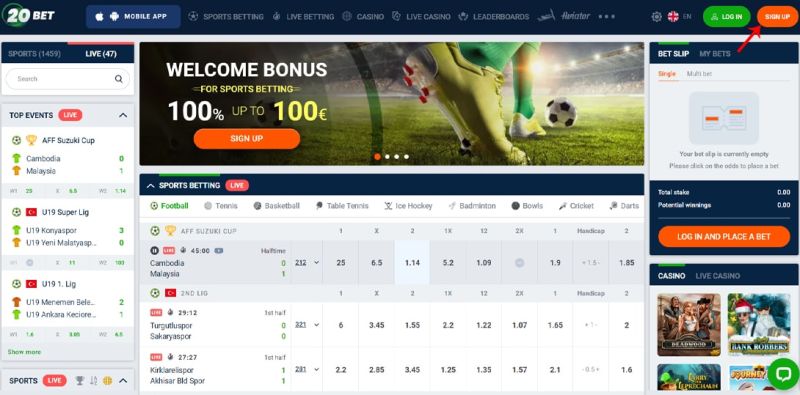
Step 2: Open the Deposit section of the cashier.
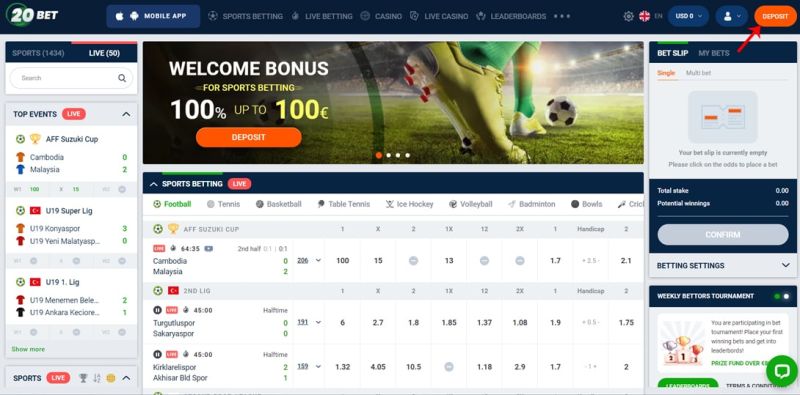
Step 3: Find the Cryptocurrencies section and select it.
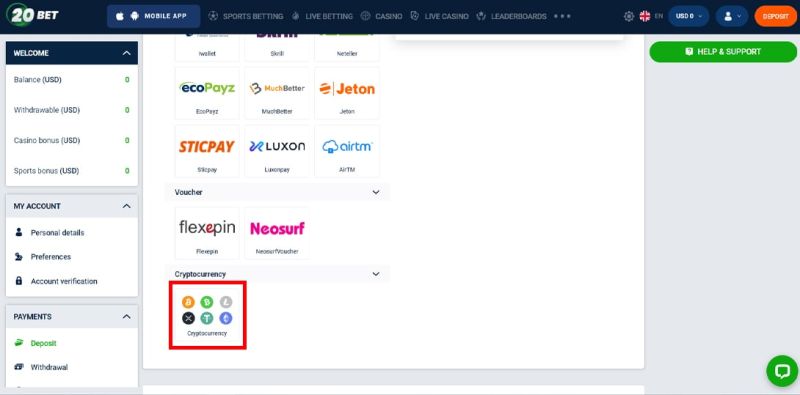
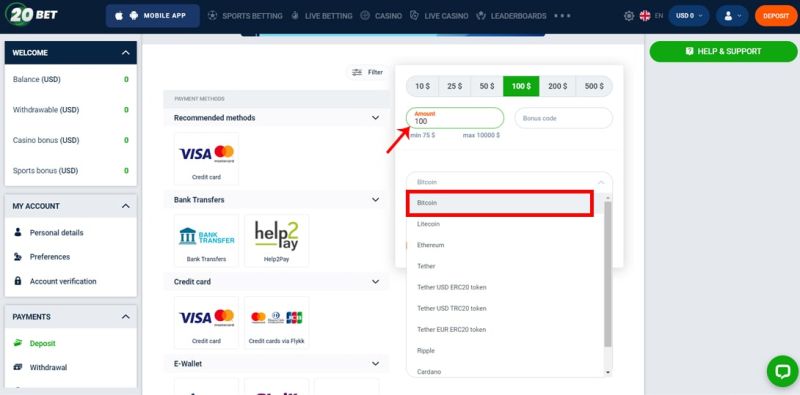
Step 4: Enter the amount, keeping it within the limits shown in the cashier, and select Bitcoin from the list of coins. When a network has to be selected, it must match the network the sending wallet uses.
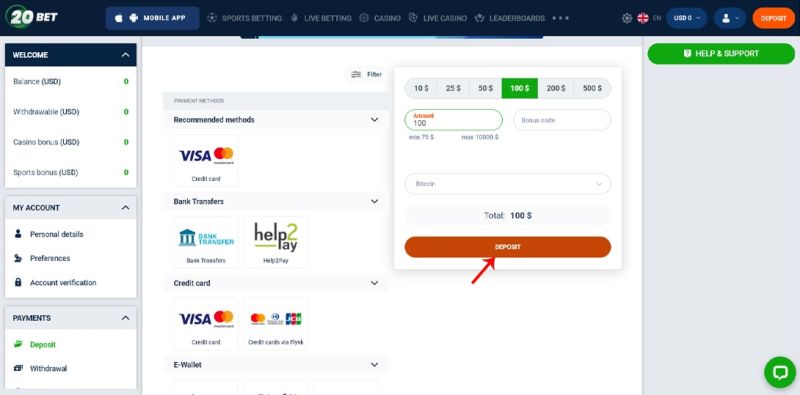
Step 5: Confirm the deposit request.
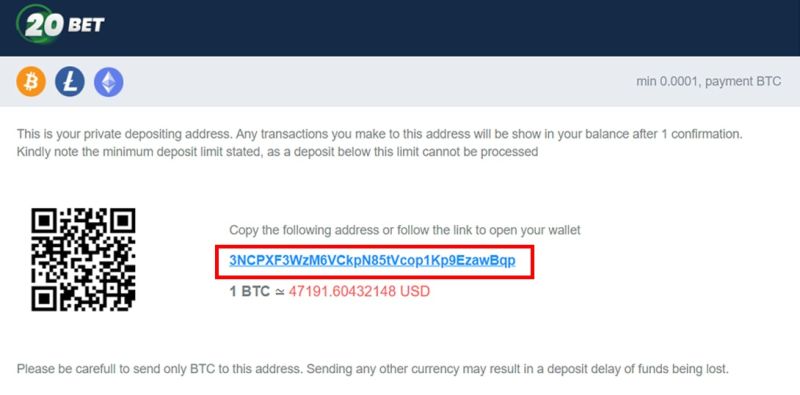
Step 6: A payment window opens with the deposit address, which may also carry a QR code and an expiry timer. The address should be copied, not entered manually, the transfer must be sent before the timer runs out, and the deposit stays pending until the required confirmations have been collected.
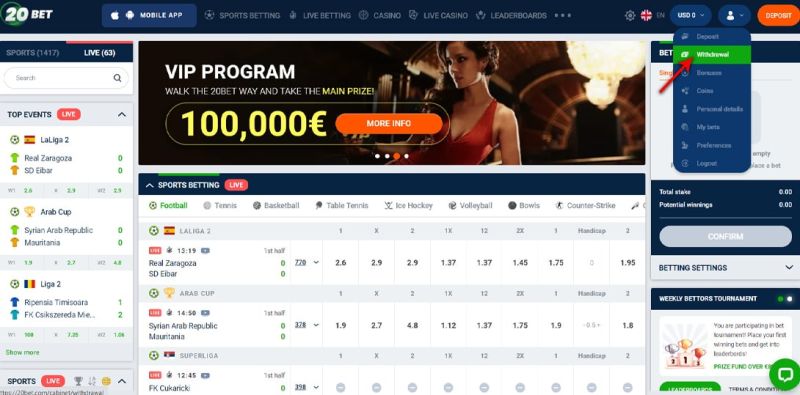
Step 1: Open My Account and select the Withdrawal menu item.
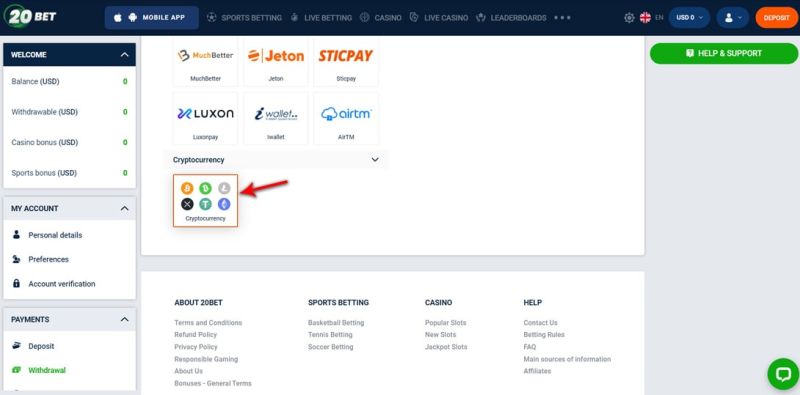
Step 2: Select the Cryptocurrencies section.
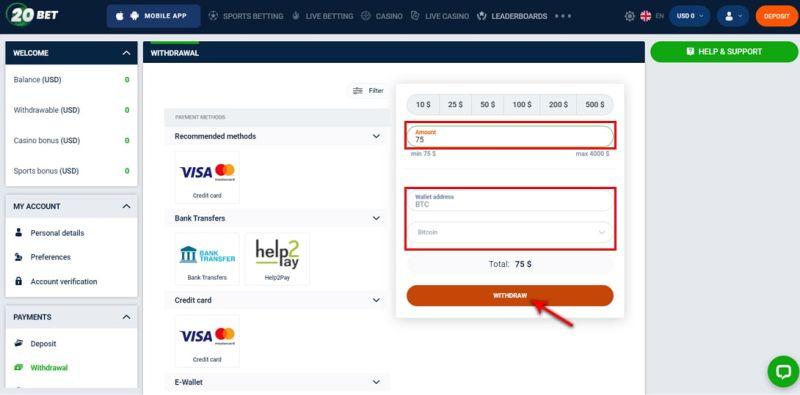
Step 3: Enter the amount, the receiving wallet address and the cryptocurrency type, then submit the request. The address belongs to the player wallet, not to the casino, and a mistake in it cannot be corrected after submission.
Many operators pay winnings back to the method used for the deposit and request identity documents before the first payout. Whether a fee is charged for the withdrawal and whether the network fee is deducted from the amount rather than added to it is stated in the cashier terms.
Bitcoin has no support desk. Once a payment is confirmed, it cannot be cancelled or reversed, so when a deposit does not arrive, the first task is to establish where it stopped.
The transaction ID is the starting point, and a block explorer answers the question in one of three ways. If the payment does not appear there at all, it was probably never broadcast or has dropped out of the mempool, and the wallet is where to look. If it appears with no confirmations, it is waiting in the mempool, which needs time or a fee increase where the sending app allows one. If it is confirmed but not credited, it sits with the operator, and support will ask for the transaction ID, both addresses, the amount, and the time of sending.
Cases where the invoice had expired, the network was wrong, or the amount fell below the cashier minimum are handled manually and need both sides: the wallet or exchange that sent the payment and the operator that was meant to receive it. Recovery in those cases may be impossible and is never guaranteed.
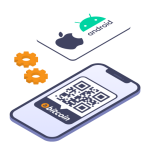
A deposit made from a phone follows the same route as from a desktop. The wallet or exchange app holds the coins, and the cash desk opens at the mobile casino website or app. On one device, the address is normally moved by copying and pasting, or through a deep link if the wallet supports one. Scanning the QR code is the convenient option when the cashier is open on a second screen, and some wallets can also read a code from a saved screenshot. Either way, the string should never be retyped by hand, which is where address errors come from.
The points below apply to the payment method itself. Individual operators add their own Bitcoin limits, fees and verification rules on top of them.
No card or bank account details are shared with the casino.
Transfers are not tied to banking hours and clear within minutes when the network is not congested.
The network fee follows the size of the transaction rather than the amount being sent.
Some operators run promotions available only for crypto deposits.
Not all online casinos accept Bitcoin.
The exchange rate fluctuates, so the credited amount balance may differ from the deposit.
A confirmed transfer cannot be reversed, and coins sent to the wrong address are rarely recoverable.
Identity verification may still apply before a withdrawal, so a crypto deposit does not make an account anonymous.
Some operators exclude crypto deposits from the welcome offer.
The list of supported coins, the networks behind each one, the minimum deposit, the confirmation threshold, and who covers the withdrawal fee vary between operators. Together, these factors decide what a deposit actually costs and how quickly it lands. The details are stated in each operator's cashier, not in the welcome offer headline. Below, you'll find more Bitcoin casinos to choose from, each with its own welcome bonus and cashier setup.
Crypto is one option among the methods available to Filipino players. The pages below cover cards, e-wallets and local rails, with the limits and processing times that apply to each.
Engaging gambling solutions are also connected with payments, and the same situation is in the Philippines. That’s why you will be engaged with the Inpay accepted casino solution, which has quite unusual mechanics.
Visa is one of the most popular payment methods globally, and it’s no surprise that many casinos now accept it.
Launched in 2010 in India, PayTM has become popular both in its native country and beyond, including the Philippines.

Among payment services in the Philippines, GCash is a convenient method, which is adored by players for fast, safe, and charge-free transactions.
Our team will tell you all you need to know, including what online casinos accept Mastercard, what to expect for deposit and withdrawal times.
Skrill is one of the biggest e-wallet providers globally and has proven that your safety and security are at the top of their priorities list.

New Casinos
New

Welcome Bonus
Welcome bonus: max. 100% up to 104,797 PHP + 150 Free Spins

Welcome Bonus
Reload Bonus: 180% to 360% + 40% to 140% Rakeback

Welcome Bonus
Max. 100% up to ₱8,888

Welcome Bonus
Welcome bonus: max. 130% up to 240,000 PHP + 700 Free Spins + 1 BG

Welcome Bonus
Welcome bonus: max. 100% up to 101,420 PHP + 150 Free Spins